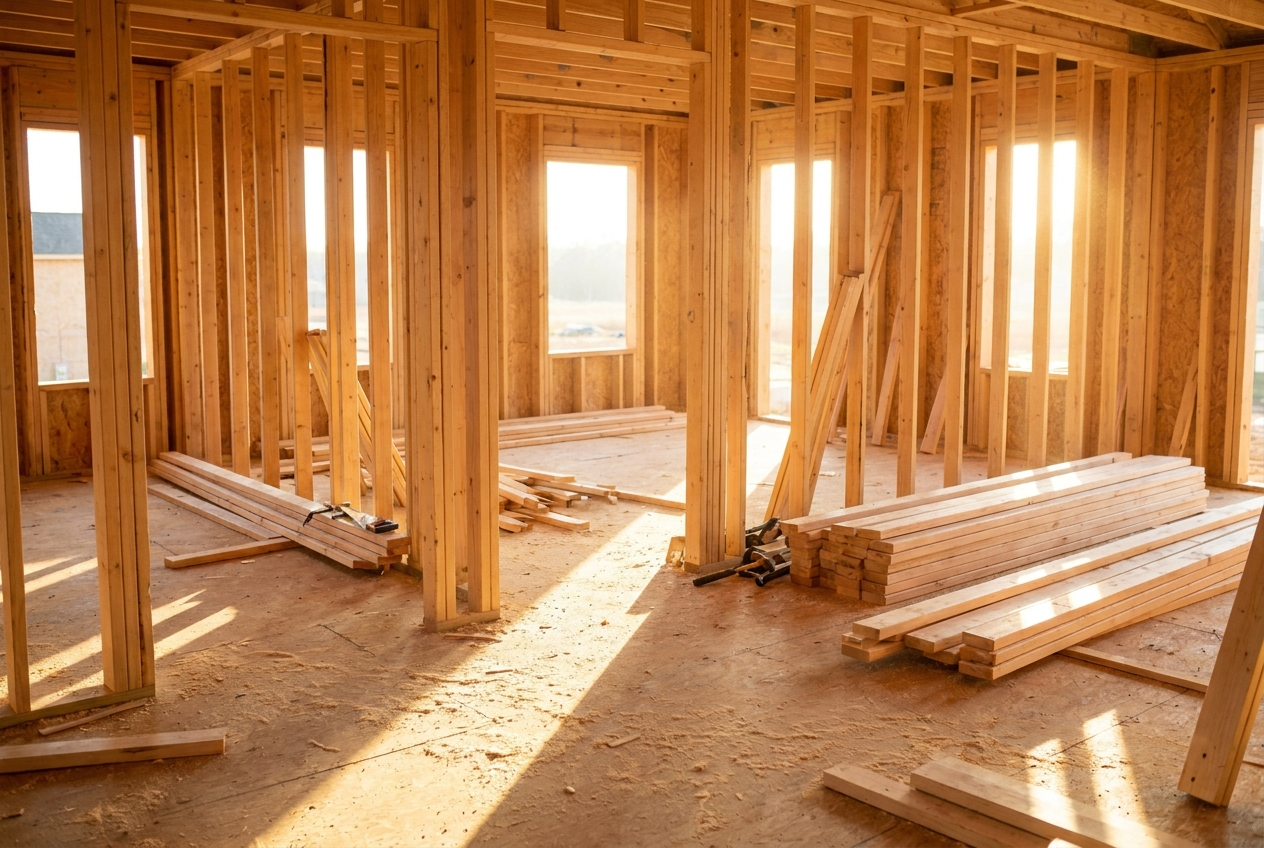
Search "framing cost per square foot" and you'll find numbers all over the map — and almost none of them will match the bids you actually receive in Los Angeles. That's not because contractors are hiding something. It's because framing isn't priced by a national average; it's priced by your plans, your lot, and your structure.
Instead of quoting numbers that won't survive first contact with your permit set, here's what actually moves a framing bid in LA — so you can read your bids like a builder.
1. The structural design, not the square footage
Two houses with identical square footage can carry very different framing costs. What matters is what the engineer drew:
- Engineered lumber. Big open spans need LVL, PSL, or glulam beams — dramatically more expensive than dimensional lumber, and heavier to set.
- Wall heights and complexity. Ten- and twelve-foot walls, vaulted ceilings, and complex rooflines all add lumber and labor.
- Steel moments. Some modern designs call for steel moment frames at big openings — a different trade riding inside the framing schedule.
2. Seismic hardware — the LA line item
California framing carries a lateral system most of the country never sees: shear walls with dense nailing schedules, holdowns, straps, and anchor hardware on nearly every run of wall. It's labor-intensive, it's inspected line-by-line, and it's non-negotiable. If a bid looks suspiciously cheap, hardware and nailing are often what got skimmed.
3. Lumber market timing
Lumber is a commodity — it moves. A bid priced in one season may not hold six months later, which is why framing quotes carry validity windows. A straight-shooting framer will tell you what's locked and what floats.
4. Your lot: flat and open vs. hillside and tight
Labor is the other half of every framing dollar, and the site sets the pace:
- Hillside lots — stepped foundations, tall cripple walls, and hand-carried material slow everything down (and much of Malibu, the Palisades, and Tujunga is hillside).
- Access. Can a truck reach the pad, or does every stick get carried through a side yard?
- Remodels and additions. Tying into an existing structure takes more skill and more time per foot than fresh ground-up walls.
5. Schedule and inspections
Framing sits in the middle of every build — foundation crews before, every other trade after. A framer who passes city inspections on the first visit keeps your whole calendar intact. One who doesn't costs you far more than the difference between bids.
How to actually budget
- Get your plans to permit-ready (or close) — real numbers need real drawings.
- Collect two or three bids on the same plan set and scope.
- Ask each bidder what's excluded. The exclusions are the bid.
- Weigh schedule and inspection track record, not just the bottom line.
O & S Framing bids from your actual plan set — every beam, every shear panel, every holdown — across North Santa Monica, Pacific Palisades, Malibu, Tujunga, and Greater LA. CA General B License #1113108 — licensed, insured & workers' comp covered.